


The Prices in NEC ECC contracts for main options A and C are the lump sum prices for each activity on the Activity Schedule, unless changed by compensation events, Defect acceptance or acceleration.
In simple terms, this is a list of activities that the Contractor has broken the project down into and put amounts of money against each item. The sum of all the line items will match the total of the Prices which the Contractor has committed to at tender stage. This bulletin will consider how the Activity Schedule is used during the life of the project and when/how it can be revised.
Option A use of the Activity Schedule: With main option A, as well as reflecting the tender price, it is also used to assess the amount due each period (typically every four weeks or month). The Contractor is paid based upon completed items on the Activity Schedule, so it is important that the Contractor breaks it down into suitably sized amounts that can be delivered within a payment interval. The level of detail the Contractor will need to break it down into will depend upon the length of and value of the project, and their own specific business sensitivity to cash flow. The Contractor is not paid for part percent complete for any single line item.
Sometimes a Project Manager may incorrectly pay part percentage of items, but this is contrary to clause 10.1 and they might change their mind at any point, hence a Contractor should not rely on this. They should take control by making sure their Activity Schedule is sufficiently granular to meet their own cash flow needs for the duration of the project. Option A also requires the Contractor to show how each item on the Activity Schedule relates to the operations on the Accepted Programme (clause 31.4).
Option C use of the Activity Schedule: With main option C there is still the same obligation to produce an Activity Schedule and submit it as part of the tender submission. The sum of the items on the Activity Schedule becomes the tendered total of the Prices and the ‘target’ at tender stage. This time however the Activity Schedule is not used to assess the Price for Work Done to Date in interim applications. The Contractor is paid based upon the forecast Defined Cost and resulting Fee which the Contractor will have incurred by the next assessment date. This comes with a lot more commercial administration compared to option A as they will have to prove their cost incurred. Under option A the Contractor does not need to demonstrate any accounts of Defined Cost incurred, but just that they have completed an individual item (and then they will be paid that amount). Upon Completion, the Contractor will share with the Client any difference between the maintained target (total of the Prices) and the cumulative Price for Work Done to Date. This is commonly known as gain/pain share (explained in more detail in CECA bulletin 28).
Would changes to descriptions/quantities in the Activity Schedule be a compensation event? The information in the Activity Schedule is not Scope or Site Information. Under option A if at any time the activities on the Activity Schedule do not relate to the Scope or the operations on the Accepted Programme, the Contractor should correct the Activity Schedule. This would not be a compensation event. Maintaining this synergy with Scope and Accepted Programme isn’t required under main Option C, however it may be good practice if the Programme and Activity Schedule are linked for the purposes of cost value reconciliation or earned value calculations.
Any errors in the preparation and pricing of the Activity Schedule (options A and C) are a Contractor risk. Correction of such errors may involve the addition of items into the Activity Schedule and a proportional redistribution of monies over the activities. This would not be a compensation event, so the total of the Prices would not be amended. The consequence to the Contractor of making a mistake in producing or pricing the Activity Schedule is greater under main Option A, since they will suffer all of the financial error. Under main Option C, the mistake will reflect in a lower than realistic target and contribute negatively to the share calculation, in accordance with the share ranges and percentages.
When is the Activity Schedule revised under option A? The Contractor can propose a revision to the Activity Schedule if:
- they change a planned method of working at their discretion that does not reflect the items on the Activity Schedule, or
- they wish to correct the activities on the Activity Schedule so that they relate to the Scope
If the Contractor changes their planned method of working e.g. is now doing what was originally a single line item as two different activities at different times, the Contractor could propose a revised Activity Schedule that reflects the new approach. This may result in a greater or fewer number of items on the Activity Schedule.
If post contract the Contractor realises they have not broken down the Activity Schedule sufficiently to afford them good cash flow, this alone is not a valid contractual reason to submit a revised Activity Schedule. However, by agreement if the Contractor proposed a revision to the Activity Schedule, the Project Manager (only if the Client agrees) could accept it if it is perceived to be in the interest of the Client/the project. However, rather than rely on something that the Client is not obliged to agree, it would be much better if the Contractor simply breaks their original Activity Schedule down into a sufficient level of detail in the first instance in Contract Data as part of their tender.
In accordance with clause 55.3, the Contractor submits a revision of the Activity Schedule to the Project Manager for acceptance. Reasons for not accepting the revised Activity Schedule (clause 55.4) include:
- the items do not relate to operations on the Accepted Programme,
- the total of the Prices is changed, or
- changed Prices are not reasonably distributed between the activities not completed (i.e. excessively front loaded).
Providing the three rules above are satisfied then the Project Manager should accept the revised Activity Schedule. Furthermore, if the revised Activity Schedule will help the Contractor by improving their cash flow and improve their ability to deliver the works then this should be beneficial to both Parties. The Project Manager should not seek to reject the revised Activity Schedule unnecessarily.
Is the Activity Schedule revised under option C? Unlike NEC3, with NEC4 for option C there is no facility to revise the Activity Schedule i.e. no equivalent clause 55.4. There is no need to revise it as the Contractor is not relying on the Activity Schedule for their interim payments as they are paid each period their actual costs incurred (but it might be sensible to do for reporting reasons).
How are compensation events dealt with under option A & C? There is no need to submit a revision to the Activity Schedule for acceptance with every compensation event. Under Option A, changes to the Prices are in the form of changes to the Activity Schedule – see clause 63.1 and clause 63.14.
The changes to the Prices are part of what is proposed in quotations for compensation events – see clause 62.2. When a quotation is accepted and compensation event implemented, the Prices are changed in the way proposed. Acceptance of a quotation is accepting the proposed way a Price is changed, not just effect on the total of the Prices.

How is a Contractor paid for compensation events under option A? The contract does not expressly state how a compensation event should be broken down to allow progressive payments. If a compensation event is for a large sum of money, the Contractor would not want to wait until it is fully complete to get any payment. It is advisable to include within the quotation the suggested break down of the Prices as to how the Contractor wants paying along the way for this new element of work.
Under Option A the Contractor has no mechanism to get paid for compensation events until they are “implemented”. In practice this can often cause issues where the Contractor is obliged to proceed with the works where they have been instructed to do so but the quotation is not yet accepted. Under option A the Contractor is paid for completed items on the Activity Schedule. The effects of a compensation event do not appear on the Activity Schedule until it is implemented. (Implemented contractually meaning agreed in terms of change to Prices/Completion and has nothing to do with the physical completion of the works.)
How is the deletion of an item on the Activity Schedule dealt with? Again, clause 63.4 states that “Assessments for changed Prices for compensation events are in the form of changes to the Activity Schedule”. This means as part of the compensation event quotation the Contractor should also state the proposed changes to the Activity Schedule.
There is no formal obligation to issue a revised Activity Schedule for acceptance every time there is a compensation event. The quotation therefore needs to confirm what the proposed changes to the Activity Schedule are in order to reflect the effects of the compensation event.
Let’s say for a project tendered at £1,000,000 there is an item on the Activity Schedule “item 105 – install draw pit gridline 7: £6,500”. If the Project Manager gives an instruction to remove this item from the Scope (CE01), then this will be a compensation event. By agreement the Price in the Activity Schedule can be used as a basis to assess the reduction in the Prices (see clause 63.2.) Otherwise it will be assessed in line with the impact on Defined Cost and resulting Fee (clause 63.1), using a full build up with Schedule of Cost Components from first principles, to assess the effect.
Either way, there needs to be an adjustment to the Activity Schedule. This could be done a number of ways, two of which are explored below:
- add a new item at the bottom of the activity schedule called CE01 “Deletion of item 105” which would be for -£6,500 (or other assessed amount if clause 63.2 is not used). The original item can be tagged as CEO1and both can then be marked as 100% complete in the next application.
- the original item is renamed or tagged as CE01, and the amount is changed to whatever the net effect of the compensation event assessment is. In the case of a 63.2 agreement to use the Price, this would be £0.
The practical benefits of option 1 is that the original total of the Prices can always be reconciled, as the original Prices as tendered will always be reflected, with the adds/omits for compensation events/acceleration reflected at the bottom of the schedule to give the current agreed revised Prices at any point in time. For both options 1&2 the Prices would now be £993,500.
How is an item amended on the Activity Schedule with a compensation event? If the same draw pit is being instructed to be amended – by adding some new stainless-steel handrails, then this time a new item can be added to the activity schedule as CE01 – £1,500 draw pit handrails. It can either be added as a new item at the bottom of the Activity Schedule or coded as a CE, so that either way you can filter the Activity Schedule to always be able to see the original tender Prices are reflected on the Activity Schedule i.e. in this example the original £1,000,000.
Example of a revised Activity Schedule
In the example below (massively simplified and high level of detail for demonstration purposes only), figure 1 shows the original Activity Schedule for an option A contract awarded at £500,000. There are then two compensation events instructed on the project.
Compensation event 1 is to remove item 2 from the Scope. The Contractor submits a quotation to show the forecast Defined Cost was £80,000 whereas the original Price in the Activity Schedule was £100,000 (Activity Schedule Prices are not used to assess compensation events unless by agreement under clause 63.2). The quotation is accepted by the Project Manager, implementing the compensation event.
Compensation event 2 is for some additional works, which the Contractor submits a quotation for £25,000 which is accepted by the Project Manager, implementing this second event too.
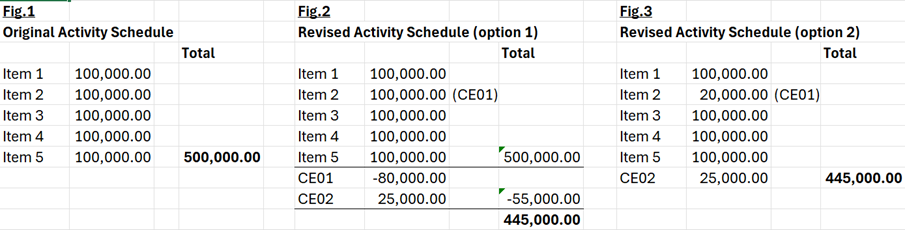
Figure 2 shows one way this could be dealt with in the form of changes to the Activity Schedule. The original item 2 is left in the activity schedule but now tagged as CE01. There is a new CE01 added to the bottom line for the agreed amount of CE01 which is -£80k, and in the application period that the compensation event has been implemented within the two amounts will be claimed for i.e. the Contractor will be paid £20k for not doing item 2.
The second compensation event for £25k will be paid for once it is completed. Any proposed change to the Activity Schedule should be confirmed within each compensation event quotation – see clause 62.2, 63.14 and 11.2(32).
By adopting this method, the original Activity Schedule value is always maintained and reconcilable with any compensation events added below the line. It shows the overall total of the Prices after the first two compensation events are implemented is now £445k, which is the original £500k, less £80k for the omission and plus £25k for the additional works.
Figure 3 alternatively shows an adjustment to item 2 and the CE02 showing as a new line item. Whilst not contractually wrong, it is potentially not as clear or easily auditable as to what the original Activity Schedule was and how/where it has changed. The overall total of the Prices is still the same i.e. £445k.
Summary: The sum of the Prices on the Activity Schedule will reflect the Total of the Prices for options A and C. It is used to assess the Price for Work Done to Date for option A, and used to set the target and assess the Contractor’s share ‘gain/pain share’ under option C. It will need to be revised for the effects of compensation events to maintain the total of the Prices at any stage of the project. Proposed changes to the Activity Schedule should be included within any compensation event quotation.