


Every two to three years, the NEC People LinkedIn group conducts a State of the Industry Survey to gather industry feedback on how effectively different aspects of the NEC contract are working in practice. (See CECA Bulletin 43 for the previous survey results.) Participants represent a broad cross-section of the construction industry, including clients, contractors, consultants, and subcontractors.
This bulletin highlights the survey’s key findings, with a particular focus on opportunities for improvement across the industry. Drawing on feedback from a diverse range of respondents, it also considers themes raised in previous bulletins to provide context and insight into the results. While the observations are not based on a precise scientific analysis, they are intended to promote greater understanding and awareness of current industry practices and challenges.
Q. Do you use a cloud-based system for managing the flow of NEC communications e.g. Digital Beehive or Cemar?

The use of such a cloud-based system can bring many benefits to a project when administering NEC contractual processes. These cloud-based systems help to provide consistency and auditability for everyone on a project and encourage responses in a timely and efficient manner (see CECA bulletin 12 for more details).
The survey results showed strong adoption of contract management systems between Clients and Contractors. Over half of respondents (53%) stated that these systems are always used, with a further 35% reporting they are used sometimes. However, 12% indicated that such systems are never used. This growing level of adoption suggests that cloud-based contract management platforms help support a more transparent, consistent, and controlled approach to contract administration.
The same level of adoption was not evident in Contractor-Subcontractor relationships. These systems can provide greater clarity, efficiency, and auditability between contractual parties, and wider use could significantly improve the management of subcontract communications. However, only 28% of respondents said they always or usually use such systems with subcontractors, while 21% use them occasionally. As a result, more than 40% do not use a contract management system at all for this critical contractual relationship.
Contractors have greater flexibility in selecting the systems they use to manage subcontractors. While existing business processes and system preferences may influence the choice, there is no requirement to use the same platform adopted by the Client. Instead, Contractors should select a system that offers the functionality, compliance, and efficiency needed to support effective contract management. Unlike their limited influence over a Client’s chosen system, Contractors can fully determine the solution used across their own supply chain. Given the variation in quality and functionality between platforms, Contractors should evaluate and test multiple options before selecting a system for wider deployment across their subcontracts.
Q. What percentage of Z clauses do you consider to be worthy, useful and contribute to making a difference to the management of that project?
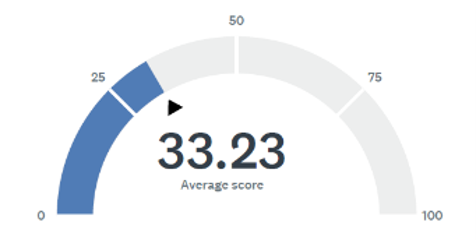
The survey results indicate that respondents believe, on average, only around one-third of Z clauses add genuine value by supporting effective contract management and risk allocation. Conversely, this suggests that approximately two-thirds are viewed as unnecessary or offering limited benefit.
There will always be a need for some bespoke amendments to address sector-specific requirements or align with a Client’s internal governance and processes. However, the findings from this and previous surveys suggest that the volume of Z clauses could potentially be reduced by more than 50% without compromising the Client’s underlying objectives. As an industry, this presents a significant opportunity for improvement.
Clients should carefully consider the purpose of each amendment and be able to clearly justify why it is necessary. Documenting the rationale for additional clauses can help demonstrate their value and ensure they address a genuine project need rather than simply becoming part of standard contractual drafting.
Greater early contractor involvement in discussions around risk allocation and the selection of Z clauses would also be beneficial. Engaging contractors at an early stage can help identify concerns before tender submission and reduce the need for challenges to clauses perceived as unclear or creating an unfair allocation of risk. Left unresolved, such concerns may lead contractors to exclude certain risks from their pricing, increase tender costs to accommodate them, or, in some cases, choose not to participate in the procurement process at all.
Key Takeaway – Z Clauses
The survey highlights a widespread perception that many Z clauses add little practical value. A more disciplined approach to drafting, supported by clear justification and early engagement with contractors, could reduce unnecessary amendments, improve risk allocation, and create a more collaborative and efficient procurement process.
Q. On average, how would you generally rate the following parties for their understanding and strict administration of the contract?
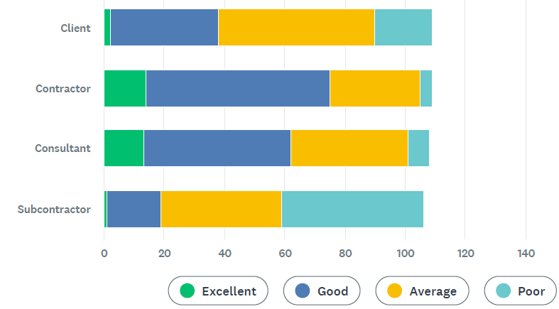
The survey asked respondents to assess the performance of four key parties involved in NEC contracts. Contractors received the highest rating, achieving an overall classification of “good”. Consultants ranked second, while Clients were rated third with an average classification of “average”. Subcontractors received the lowest rating, with their overall average performance classified as “poor”.
This result may be linked to an earlier survey finding that cloud-based contract management systems are used less frequently between Contractors and Subcontractors than between Clients and Contractors. Reduced use of these systems can limit visibility, consistency, and compliance in contractual communications and processes.
Given that Subcontractors undertake a significant proportion of project delivery, improving their understanding and management of NEC contracts could generate substantial benefits for project outcomes. To support this, Contractors could consider:
- Assessing NEC4 competence as part of their supply chain selection and recruitment process.
- Providing targeted NEC training and awareness sessions for Subcontractors and supply chain partners.
- Delivering project-specific NEC inductions covering key contract requirements, project procedures, and bespoke contract clauses.
- Using NEC short-form contracts where the scope of works is straightforward and the associated risks are relatively low.
- Implementing cloud-based contract management systems to support the timely and compliant exchange of contractual communications and to help Subcontractors follow contractual processes and timescales.
Key Takeaway- Contract Administration
The survey suggests that improving NEC capability within the supply chain represents a significant opportunity for the industry. By investing in training, simplifying contract arrangements where appropriate, and adopting robust contract management systems, Contractors can help Subcontractors operate more effectively, leading to better compliance, communication, and project performance.
Q. Do you normally undertake joint contract training between the different Parties on a particular project?
Only 9% of survey respondents said they always conduct NEC contract workshops on their current or recent projects. A further 36% said they do so sometimes, while 55% reported that they rarely or never hold such sessions. These figures represent a decline from previous surveys, suggesting that joint contract workshops are becoming less common across the industry.
One possible reason is the perception that, because NEC contracts have been widely used for many years, project participants are already familiar with their requirements. However, the survey findings suggest that there remains considerable value in bringing project teams together at the outset of a project to review both the standard contract provisions and any project-specific amendments.
Early contract workshops help establish a shared understanding of key contractual obligations, processes, and responsibilities. By ensuring that all parties hear and discuss the contract requirements in a collaborative environment, these sessions can promote consistent contract administration, reduce misunderstandings, and support a more constructive approach to project delivery.
Key Takeaway – NEC Contract Workshops
The declining use of NEC contract workshops may be a missed opportunity. Investing time at the start of a project to review the contract and its key processes can improve understanding, strengthen collaboration, and help both Parties administer the contract more effectively throughout the project lifecycle.
Q. Are early warnings ever taken negatively – i.e. seen merely as a commercial tool from another Party?
Previous bulletins have emphasised the importance of the early warning process as a proactive project management tool rather than a contractual or commercial mechanism (see CECA Bulletin 42). However, the survey results indicate that this principle is still not widely embraced in practice. Almost half of respondents (47%) reported that early warnings are often viewed as a commercial tool, while only 13% said they are rarely or never treated in this way.
The purpose of an early warning is to identify potential issues that could affect time, cost, quality, or performance at the earliest opportunity. It is intended to encourage open discussion between the Parties, enabling them to agree actions that can either avoid the issue altogether or minimise its impact. By addressing risks early, the process can often prevent a compensation event from occurring or significantly reduce its financial and programme consequences.
When used as intended, early warnings benefit both Parties by promoting collaboration, improving decision-making, and reducing project risk. They should therefore be viewed as a key project management tool and actively encouraged throughout the lifecycle of the project.
Key Takeaway – Perception
The survey highlights an ongoing misconception that early warnings are primarily commercial in nature. Shifting this perception and embracing the process as a proactive risk management tool would improve collaboration, support better project outcomes, and help minimise the cost and programme impacts of emerging issues.
Q. Does cost appear to be a big focus or consideration in the notification of an early warning and within the discussions of the early warning meetings?

The survey results suggest that cost remains a dominant focus within the early warning process. Over half of respondents (54%) stated that discussions around early warnings are often centred on cost, while only 10% felt that cost is rarely the primary consideration.
However, the NEC contract envisages a different purpose for the process. The Early Warning Register is a defined term that requires the matter to be described, and the agreed actions recorded to either avoid the issue or mitigate its impact. The primary objective is therefore proactive risk management rather than determining financial liability.
Where agreed actions ultimately give rise to a compensation event, this should be notified and assessed through the separate compensation event process. That process is specifically designed to address any associated cost and time implications. As a result, detailed discussion of liability or financial entitlement does not need to dominate the initial early warning discussions.
The focus of an early warning meeting should be on collaboration and problem-solving. Regardless of which Party may ultimately be responsible, the priority should be identifying practical actions that minimise the impact of the issue on the project. By maintaining this approach, the Parties can reduce risk, improve outcomes, and make more effective use of one of NEC’s most valuable management tools.
Key Takeaway – Focus
The survey highlights that cost considerations often overshadow the intended purpose of the early warning process. To realise the full benefits of NEC contracts, Parties should focus early warning discussions on risk mitigation and collaborative problem-solving, leaving questions of entitlement and compensation to the separate compensation event process.
Q. Are commercial people present at early warning meetings?
The response to this question may help explain the findings of the previous one. Of those surveyed, 83% reported that commercial personnel are regularly present at early warning meetings. While commercial teams play an important role in contract management, their involvement at this stage can influence the focus and dynamic of discussions.
The purpose of an early warning meeting is to identify actions that can avoid or reduce the impact of a potential issue on the project. The discussion should centre on risk management, collaboration, and problem-solving, rather than on questions of cost, liability, or fault.
Under the NEC contract, the Project Manager is required to update the Early Warning Register within one week of the meeting. This register records the matter raised and the actions agreed, providing the information needed for commercial teams to subsequently assess whether a compensation event should be notified. Any entitlement, liability, cost, or time implications can then be addressed through the appropriate contractual processes.
For this reason, there is no requirement for early warning meetings to become commercially focused. Allowing these discussions to remain centred on mitigation and project outcomes can encourage more open dialogue, better collaboration, and more effective risk management.
Key Takeaway – Influences
The survey suggests that the strong presence of commercial personnel at early warning meetings may contribute to an overemphasis on cost and liability. To maximise the value of the early warning process, meetings should focus on identifying practical solutions and mitigating risks, leaving commercial assessments to the subsequent contract administration processes.
Q. How often do you normally hold specific early warning meetings on a project to discuss early warnings?
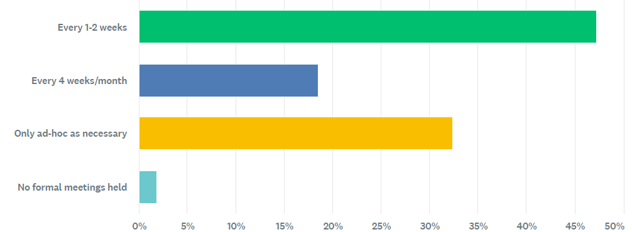
The survey found that around two-thirds of respondents hold early warning meetings at least once a month. This represents an increase compared to previous years and is likely influenced by the NEC4 requirement for the Client to state the “early warning meeting interval” in the Contract Data. Approximately one-third of respondents said that meetings are held on an ad hoc basis as issues arise, while fewer than 3% reported that they do not hold early warning meetings at all.
These results suggest that the early warning process is generally being implemented and that regular meetings are now an established feature of most NEC projects. However, when considered alongside the responses to earlier survey questions, there is evidence that the effectiveness of these meetings could be improved. While the meetings are taking place, discussions often appear to be focused on commercial matters rather than the collaborative risk management objectives intended by the contract.
To maximise their value, early warning meetings should remain focused on identifying potential risks, agreeing mitigation measures, and reducing the impact of issues on project outcomes. Maintaining this proactive and collaborative approach will help ensure that the process delivers the benefits envisaged by NEC.
Key Takeaway – Meeting Focus
The survey indicates that regular early warning meetings are now common practice across the industry. The challenge is no longer whether meetings are being held, but whether they are being used as intended. A greater focus on risk mitigation and collaborative problem-solving, rather than commercial considerations, would help the process deliver its full value.
Q. Do you think the early warning process/Early Warning Register achieves on its goal of effectively managing risk and avoiding/minimising cost of compensation events?
The survey revealed that 33% of respondents do not believe the early warning process is achieving its intended objectives. This is a disappointing result given that the process is designed to be one of the simplest and most proactive features of the NEC contract.
At its core, the early warning process is straightforward. It involves identifying an issue that could potentially affect the project and bringing it to the attention of the relevant parties at the earliest opportunity. The focus should then be on discussing and agreeing practical actions to avoid the issue or minimise its impact.
The process is not intended to be complex or adversarial. Rather, it is a structured way of increasing awareness, promoting collaboration, and ensuring that those best placed to address emerging risks are involved at an early stage. By encouraging timely communication and proactive decision-making, the process supports effective project delivery and reduces the likelihood of issues escalating into more significant problems.
The survey findings suggest that the industry’s challenge is not understanding the mechanics of the process, but ensuring it is consistently applied as a project management tool rather than viewed through a commercial or contractual lens. When used as intended, early warnings represent little more than good project management practice, providing benefits to all parties involved in the project.
Key Takeaway – Project Management
The survey highlights a concerning perception that the early warning process is not always delivering its intended benefits. Greater emphasis on its primary purpose, namely early identification of risks and collaborative mitigation of potential issues, could help unlock the full value of what is fundamentally a simple but highly effective project management tool.
Q. How frequently is a revised programme that has been issued for acceptance formally accepted on your project(s)?
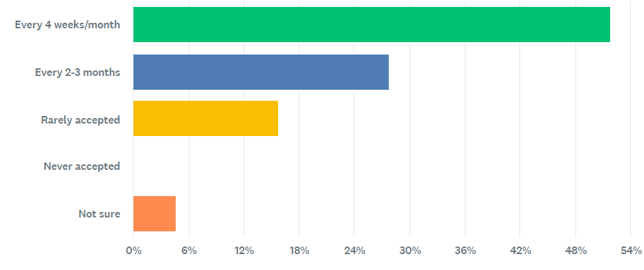
Only half of respondents reported achieving an Accepted Programme in every reporting period. A further 28% said programme acceptance is only achieved every two to three months, while 16% stated that programmes are rarely, if ever, accepted. This is a concern, as it is in the interests of both Parties to maintain an Accepted Programme at all times (see CECA Bulletin 6).
Compensation events are assessed against the most recently Accepted Programme. Where this programme is several months out of date, assessments can become more subjective, time-consuming, and potentially contentious. The situation is further complicated when additional compensation events arise before a revised programme has been accepted.
Improving these outcomes requires commitment from both Parties. Contractors should ensure that submitted programmes fully comply with contractual requirements, leaving the Project Manager with no valid reason to reject them. Equally, Project Managers should review submissions objectively and, where acceptance is withheld, provide clear and detailed reasons so that any deficiencies can be promptly addressed.
Where comments are received, Contractors should seek to revise and resubmit the programme within the same reporting period rather than waiting until the next scheduled update. This helps maintain progress towards achieving an Accepted Programme and reduces unnecessary delays.
The submission of a programme narrative alongside each update (see CECA Bulletin 56) can also support the acceptance process. A narrative helps explain programme logic, critical changes, revised durations, and key assumptions, enabling the Project Manager to better understand the submission. Regular programme review meetings can provide a further opportunity to present the programme, answer questions, and resolve concerns before acceptance is due, increasing the likelihood of a positive outcome.
It is also important that Project Managers fully understand the implications of programme acceptance. Accepting a programme does not alter contractual completion dates, determine liability, or approve the time or cost consequences of compensation events. These matters can only be addressed through the compensation event process. Clause 14.1 makes clear that programme acceptance does not change the Contractor’s obligation to provide the works or its liability for design (see CECA Bulletin 61). Understanding this distinction may help remove any unnecessary reluctance to accept compliant programme submissions.
Key Takeaway – Mutual Benefit of Accepted Programmes
Maintaining a regularly updated and Accepted Programme should be a shared objective for both Parties. An up-to-date Accepted Programme provides a reliable basis for project management and compensation event assessment, reducing uncertainty and the potential for dispute. Clear submissions, prompt feedback, effective communication, and a better understanding of the implications of programme acceptance can all help improve performance in this critical area of NEC contract administration.
Summary: The survey suggests that while NEC contracts are widely adopted and many of their core processes are being implemented, there remains significant scope for improvement. Key priorities include expanding digital contract management systems throughout the supply chain, reducing unnecessary Z clauses, improving a wider industry competence, reinstating contract workshops, refocusing the early warning process on risk mitigation rather than commercial issues, and achieving more consistent programme acceptance. Collectively, these improvements would strengthen collaboration, improve contractual compliance, and help projects realise the full benefits of the NEC philosophy.