


NEC contracts include the potential for having agreed rates for equipment included within a contract. These rates will be used in the agreement of costs during the life of a project. This bulletin will consider how and when those equipment rates will come into play and the use/relevance of the latest schedule produced by CECA to potentially assist in this process.
Why use pre-agreed rates generally? By having such a pre-agreed list will reduce the amount of administration and requirements for audits for agreement of such matters. These will form part of the competitive tender process for projects and reduce the risk of disputes when assessing costs, as the rates are agreed and not subject to challenge.
NEC Contract Data part 2: Many of the different types of NEC contracts require the tendering party to agree equipment rates as part of their tender submission. This will form part of the tender evaluation, as what may appear to be the cheapest tender price may not be the cheapest final overall cost paid by the end of the project, depending on the level of change and the rates that had been applied.
NEC cost reimbursable type contracts: In the ECC contract where options C, D or E have been chosen, within Contract Data part 2 there is the requirement for the Contractor to list items of equipment they have purchased for work on the contract and the associated charge out rate applicable for that item that will be charged on that project. There is also the opportunity to list rates for “special Equipment”. All other Equipment rates will simply be recoverable as part of section 2 of the schedule of cost components as actual costs incurred (or forecast to incur).
NEC fixed price/lump sum type contracts: In the ECC contract where options A or B have been chosen, Contract Data part 2 requires three data elements to be populated by the Contractor at tender stage (i.e. prior to signing the contract):
- Published list of Equipment is the edition current at the Contract Date of the list published by…
- Percentage for adjustment for Equipment in the published list is…
- Rates for other Equipment are …
Item 1 allows the Contractor to state which recognised industry list of equipment will be used for the purpose of pricing compensation events. The provision of both people and equipment pre-agreed in these types of contracts will mean there is less subjectivity/disputes when assessing the cost of change.
Item 2 allows the Contractor to agree an adjustment factor if it is considered that the rates in the Equipment list are generally higher or lower that the Contractor believes may be applicable for that sector or type of project. This is intended to be a flat percentage rate across the board for all items of equipment. This can be a positive percentage if the Contractor believes the rates are too low, or a negative percentage if the Contractor feels the rates are higher than necessary. This will form part of the tender evaluation process as to how competitive the overall Contractor’s tender price is judged to be. A widely used list used in the construction industry is the one published by CECA, which will be reviewed within this bulletin.
Item 3 allows other rates for Equipment not included within the published list to be listed and priced. This would generally be for very specialist types of equipment that are not as widely used in construction projects. If for any reason there is an item of Equipment that is not covered within the schedule or the rates listed in Contract Data, it will simply be assessed using competitively tendered or open market rates at that point in time
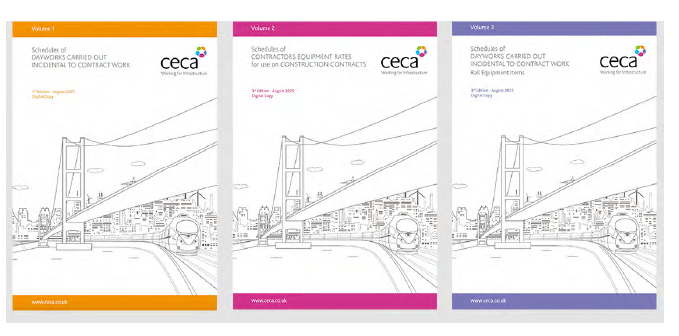
CECA Daywork Schedule: CECA have just published the 3rd edition of the CECA Daywork Schedule which was effective from the 11th August 2025. It follows a comprehensive review and update from the previous 2022 version. It seeks to reflect current industry practice to indicate rates for key items widely used across the construction industry. The latest update includes removing obsolete items and clarification on the use of hired equipment under specific circumstances. It is now structured across three volumes:
- Volume 1 – Schedules of Dayworks carried out incidental to contract work
- Volume 2 – Schedules of contractors’ equipment rates for use in construction contracts
- Volume 3 – Schedules of contractors’ equipment rates for use in rail contracts
The volumes can be used collectively or individually as relevant/applicable to a particular project. In particular, volumes 2 and/or 3 can support pricing of work using equipment rates alone.
Volume 1 – Schedules of Dayworks: Whilst used as a general industry term it is not really relevant to NEC contracts. The equivalent of “Dayworks” under NEC contracts would be to build up the Defined Cost (mainly for people) using the relevant Schedule of Cost Components (SCC) in the NEC contract. Under the fixed price contracts (e.g. ECC and ECS options A/B) there are pre-agreed people rates included in contract data part 2. For cost reimbursable contracts (e.g. ECC and ECS options C/D/E) the cost of people are built up from first principles using the headings within section 1 of the SCC (see CECA bulletin 23 for more details on Defined Cost/SCC).
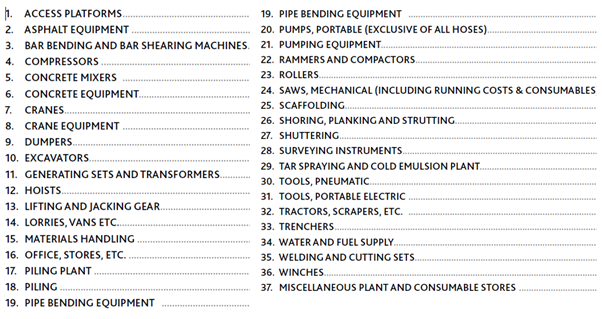
Volume 2 – Contractors Equipment Rates: Below is a full list of the equipment headings that are included within the schedule. The rates listed are generally on an hourly rate unless otherwise stated.
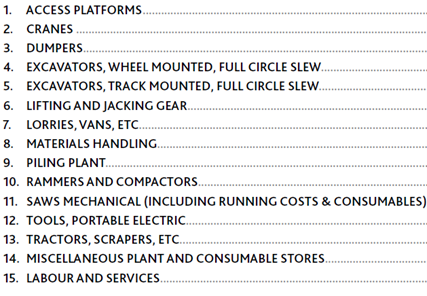
Volume 3 – Rail Equipment Items: This schedule specifically covers the types of equipment that are likely to be used on rail related projects. The list specifically covers:
Summary: It is hugely beneficial to agree Equipment rates to be used prior to signing a contract so that there are less areas of dispute when assessing costs on a project. The Equipment list produced by CECA will be relevant/useful for NEC fixed price/lump sum contracts where such a list is required to be chosen within Contract Data part 2 by the Contractor/Subcontractor who is tendering for the project.