---
title: Engineering and Construction Short Contract (ECSC) - CECA Bulletin 32 - Engineering and Construction Short Contract (ECSC)
date: 2023-07-31T17:48:23Z
modified: 2024-12-30T14:19:03Z
permalink: "https://gmhplanning.co.uk/nec-downloads/nec4-engineering-and-construction-short-contract/"
type: downloads
status: publish
excerpt: ""
wpid: 5245
nec_contract_type:
- NEC4
nec_contract_version:
- NEC Engineering and Construction Short Contract (ECSC)
download_category:
- CECA Bulletins
- Contract types & documentation
featured_image: "https://gmhplanning.co.uk/wp-content/uploads/2024/02/GMH-CECA-NEC-Bulletin-Member-Briefing.jpg"
featured_image_alt: Cover image for CECA NEC4 Bulletin CECA Member Briefings by GMH Planning Ltd
author: Glenn Hide
timestamp: 2024-12-30T14:19:03Z
tags:
- NEC4
- NEC Engineering and Construction Short Contract (ECSC)
- CECA Bulletins
- Contract types & documentation
---

NEC4 Engineering and Construction Contract Short Contract ECSCThe most common contract used between the Client and Contractor for construction/building type works is the Engineering and Construction Contract **(ECC).** However, when a project is relatively low risk and straight forward the Engineering and Construction Short Contract **(ECSC)** is often adopted instead. Being a shorter and simpler version of the full ECC, it avoids the need for the full extent of the administration required in the ECC, for what are intended to be simpler works. There is no specific formula to determine whether either the ECC or the ECSC should be adopted for a scheme relying instead on a judgement call by the client organisation based on its complexity and perceived risk profile.
**Format:** The ECSC book is laid out slightly differently to the ECC. The ECC is split into five sections: core clauses, primary options, secondary options, schedule of cost components and contract data, whereas the ECSC is simply split into two sections: contract data and conditions of contract. There is only one choice of primary option (which is a hybrid of ECC options A & B) and no choice of secondary options (although the equivalent of some of the ECC secondary options are included by default into Contract Data). There is no Project Manager or Supervisor role identified as there is in the ECC, and the works are simply managed by the _Client_.
**Client’s Contract Data:** The _Client_ will complete the first two pages of the contract and will contain the information the _Contractor_ needs to take into consideration when they are tendering. It includes such matters as:
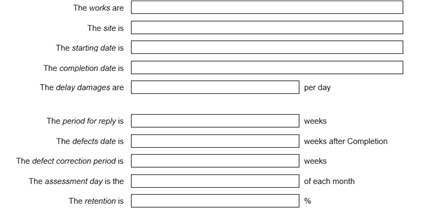
- who the _Client_ is and their electronic address for communications
- description of _the works_
- _starting date_ (date the contract will commence)
- _completion date_ (date the _Contractor_ needs to complete by to avoid paying delay damages)
- the _delay damages_ (the daily cost the _Contractor_ will be charged for exceeding the Completion Date)
- what the _defect date_ is (the period for which the _Contractor_ is liable for defects)
- what the _defect correction period_ is (period within which the _Contractor_ has to correct a defect within)
- what the _assessment day_ is each month
- what the _retention_ percentage is
- what the _interest rate_ is for late payments
- liability of the _Contractor_ to the _Client_ for loss of or damage to the Client’s property
- insurance cover amounts required
- any additional conditions of contract
**Contractor’s Contract Data:** The _Contractor_ will then complete the third page of the contract with information they are committing to at tender stage:
- who the _Contractor_ is and their electronic address for communications
- the _fee percentage_ (to be applied in the event of compensation event quotations)
- _people rates_ (to be applied in the build-up of compensation event quotations)
- _published list of Equipment_ (to be applied in the build-up of compensation event quotations)
**Contractor’s Offer and Client’s Acceptance**: This section states the offered total of the Prices, and is then signed on behalf of both the _Contractor_ and _Client._

**Price List:** This is created either by the _Client_ or _Contractor_ or jointly at tender stage. It can be a combination of ‘lump sum’ items (for which the cost will not vary with quantity) and ‘quantity’ related items (for which the cost will vary with a change in quantity). For the lump sum items, only the item number, description and price columns will be populated. For the quantity related items, the unit, quantity and rate columns will also be completed. The sum of each line item will add up to the overall total of the Prices. Any method and rules used to compile the Price List are also stated.
**Scope:** This is intended to be a complete and precise statement of the _Client’s_ requirements so that the _Contractor_ is very clear on what they are pricing and programming. Any information will only be provided and listed by the _Contractor_ in this section where the _Client_ agrees it is necessary.
It is split into six sections:
1. description of the works (describing what the _Contractor_ is to do and any work the _Contractor_ is to design)
2. drawings (list of relevant drawings that apply to the contract)
3. specifications (list of relevant specifications that apply to the contract)
4. constraints on how the _Contractor_ Provides the Works (including any timings and sequencing, and requirements for any work by the _Client_)
5. requirements for the programme (stating whether a programme is required, what format, what information is required to be shown, when to be submitted and when to be updated)
6. services and other things to be provided by the _Client_ (describing what the _Client_ will provide, such as services, and any “free issue” Plant and Materials and equipment)
**Site Information:** This will provide known information about the site, such as ground conditions, positions of adjacent structures, and any other information likely to affect the _Contractor’s_ works.
**Conditions of Contract:** These are much more concise compared to the ECC and only seventeen pages of content, but split into the same 9 headings:
**Section 1 – General:** There are 16 defined terms included in clause 11.2 such as Completion, Defined Cost, Price for Work Done to Date and Scope. It confirms that all communications have to be in a form that can be read, copied and recorded. It includes section 15 for issuing and managing early warnings, although it is simplified compared to the ECC and does not formalise early warning meetings or mandate the production and issue of a formal Early Warning Register.
**Section 2 – Contractor’s main responsibilities:** This states that the _Contractor_ provides the works in accordance with the Scope, and that where there is an element of _Contractor_ design, those elements do not proceed until the _Client_ has accepted the design. There is no obligation for Subcontractors to be formally issued for acceptance like in the ECC.
**Section 3 – Time:** This is much more simplified compared to the ECC and simply states that the _Contractor_ submits programmes to the _Client_ as stated within the Scope. It is essential therefore that the _Client_ includes in the Scope all the elements that they require to shown and when it is to be issued. Otherwise, the only default requirement as stated will be for the _Contractor_ to submit a forecast of the date of Completion each week (from the _starting date_ to Completion). There is no provision for Key Dates or sectional Completion Dates like in the ECC.
**Section 4 – Quality Management:** This section includes brief details/rules on tests and inspections, searching for defects, correcting defects, accepting defects and what happens in the event of uncorrected defects. The role of the ECC Supervisor is simply carried out by the Client.
**Section 5 – Payment:** Assessing the amount due is very similar to the ECC in terms of the rules for submitting and assessing a payment application. An important element that was introduced to NEC4 was that if there is no application submitted by the _Contractor_ then the assessment that period will be zero. One quarter of the Price for Work Done to Date can also be withheld if the _Contractor_ has not submitted a programme showing the information the Scope requires. This section also confirms that delay damages and retention will be applied in each assessment where applicable. Payments are made within three weeks of the assessment date, and interest is due on any late payments by the _Client_.
**Section 6 – Compensation events:** This is slightly simplified compared to the ECC contract. The number of compensation events listed in 60.1 is reduced to twelve. The time-bar in which the _Contractor_ is obliged to notify the compensation event within (for events they are obliged to notify) is reduced to four weeks. If the _Contractor_ notifies the compensation event at the same time they also include the quotation. Otherwise, the _Contractor_ provides the quotation within one week if notified by the _Client. Contractor_ can state assumptions in the quotation upon which they have based the quotation (which if later found to be wrong will be a new compensation event). _Client_ should respond to a quotation within two weeks, and failure to do so will mean that the quote is instantly “deemed accepted”. No formal details of any revised quotation and it is the Client to simply make their own assessment if they do not agree.
**Pricing compensation events:** There is no schedule of cost components within the ECSC. For events that only affect the quantities in the Price List, the change to the Prices is assessed using those prices in the Price List. For all other events the compensation is based upon a simpler definition of Defined Cost, which is made up of
- People, calculated by using People Rates in Contract Data
- Plant and Materials as the amount paid by the _Contractor_
- amount paid by _Contractor_ to any subcontractor to any works subcontracted
- Equipment, using the published list of Equipment (or at open market rates where not in published list)
Fee is also then applicable to the calculated total amount of Defined Cost.
**Section 8 – Liabilities and Insurances:** This section identifies _Client’s_ liabilities, _Contractor’s_ liabilities, and any insurance covers required.
**Section 9 – Termination and resolving disputes:** This section covers a much simpler section on reasons for termination, procedures to follow upon termination, and the amount to be paid. Section 93 also deals with the dispute process which is by going straight to adjudication.

**Other short contracts**: In addition to the ECC having a short contract equivalent, there are similar simpler versions of the Engineering and Construction Subcontract (ECSS), Professional Services Contract (PSSC), Term Service Contract (TSSC) and Supply Contract (SSC). These have a similar principle, in that they are simpler versions of the full contract equivalents, and to be used for simpler lower risk projects.
**Summary:** The Engineering and Construction Short Contract is a simpler version of the contract and suitable for lower risk more straightforward works. It is simpler to use and less procedural/administrative. For the same reason, it should not be chosen as a perceived “easy option” to administer more complex projects, as it does not have the procedures and processes necessary to administer them effectively.
[CECA NEC Bulletin No. 32 – Engineering and Construction Short Contract ECSC – August 2023](https://gmhplanning.co.uk/wp-content/uploads/2023/07/CECA-NEC-Bulletin-No.-32-Engineering-and-Construction-Short-Contract-ECSC-August-2023.pdf)[Download](https://gmhplanning.co.uk/wp-content/uploads/2023/07/CECA-NEC-Bulletin-No.-32-Engineering-and-Construction-Short-Contract-ECSC-August-2023.pdf)
## Topics
**NEC Contract Editions:** [NEC4](https://gmhplanning.co.uk/wp-content/uploads/wp-mfa-exports/taxonomy/nec_contract_type/nec4.md)
**NEC Contract Versions:** [NEC Engineering and Construction Short Contract (ECSC)](https://gmhplanning.co.uk/wp-content/uploads/wp-mfa-exports/taxonomy/nec_contract_version/nec-engineering-and-construction-short-contract-ecsc.md)
**Download Categories:** [CECA Bulletins](https://gmhplanning.co.uk/wp-content/uploads/wp-mfa-exports/taxonomy/download_category/ceca-bulletins.md), [Contract types & documentation](https://gmhplanning.co.uk/wp-content/uploads/wp-mfa-exports/taxonomy/download_category/contract-types-documentation.md)